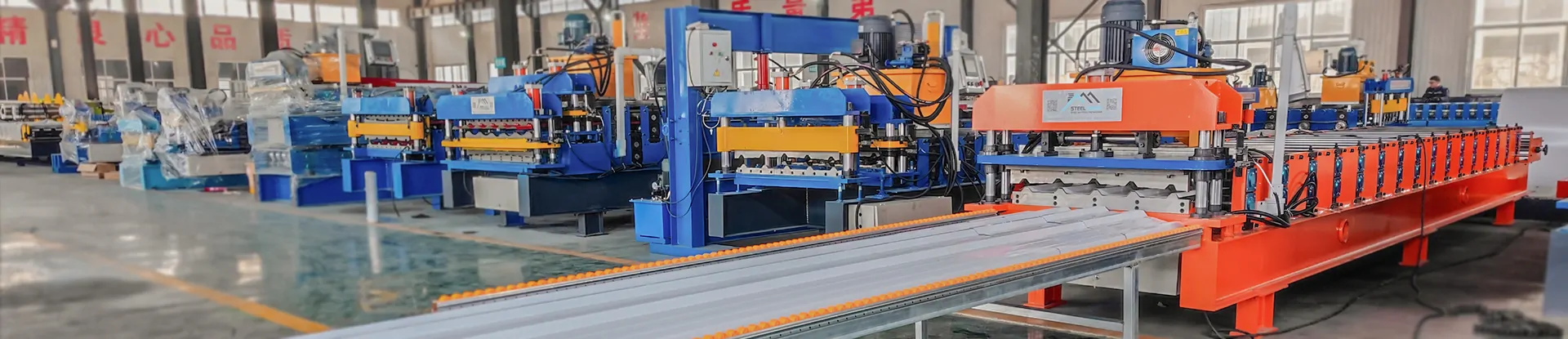
Views: 265 Author: steemama Publish Time: 2026-05-27 Origin: Curving Roll Forming Machine
If you specialize in architectural metalwork or industrial roofing, you’ve likely encountered the challenge of creating curved panels for arched roofs, tunnels, or decorative facades. Enter the curving vertical roll forming machine — a specialized piece of equipment that combines vertical panel formation with in-line curving capabilities.
In this guide, we’ll explain what a galvanized Curving roof sheet roll forming machine is, how it works, and why it’s becoming essential for U.S. construction projects requiring elegant, continuous curves.
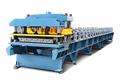
A curving vertical roll forming machine is an advanced metal forming system that produces curved profiles — typically standing seam panels or trapezoidal sheets — with the curve introduced during the forming process itself. Unlike standard roll formers that create only flat, linear panels, a curving vertical machine bends the profile vertically (along its standing leg axis) to achieve smooth, consistent arcs.
These machines are widely used to manufacture panels for:
Barrel-vaulted roofs
Circular stadium canopies
Curved building facades
Arched agricultural buildings
Tunnel liners and silos
The operation of a curving vertical roll forming machine involves three key stages:
A metal coil (typically galvanized steel, aluminum, or copper) is loaded onto an uncoiler and fed into the roll forming section. The initial rollers shape the flat strip into a vertical profile — for example, a standing seam with raised legs or a corrugated rib pattern.
This is where the Curving roofing sheet rolling machine differs from conventional equipment. As the formed profile moves forward, it passes through a curving station equipped with adjustable rollers or a three-roll bender. These rollers apply lateral pressure to the vertical legs of the profile, gradually bending the entire panel into a predetermined radius — either concave (curving downward) or convex (curving upward).
Once the desired curve is achieved, a flying cut-off system shears the curved panel to length without stopping production. Advanced models include automatic stackers designed to handle curved sections without damage.
The entire process is controlled by a PLC system that synchronizes roll forming speed, curving pressure, and cut length — ensuring consistent radius across hundreds of feet.
Why invest in a dedicated curving vertical roll forming machine instead of using a separate curving attachment? Here are the benefits:
Higher precision – Curving is integrated into the same production line, eliminating alignment errors.
Faster production – No need to transfer panels to a secondary curving machine.
Tighter radii – Vertical curving allows smaller radii (as tight as 2–3 feet) compared to horizontal curving methods.
Reduced material waste – Continuous forming and curving means fewer end trims.
Lower labor costs – One operator can manage the entire process.
A versatile curving vertical roll forming machine can produce multiple panel geometries:
Curved standing seam panels (snap-lock or mechanical-lock)
Curved corrugated sheets
Curved trapezoidal ribs
Custom architectural curves for rain screens or cladding
A curving vertical roll forming machine is a game-changer for metal roofing and architectural cladding professionals. By combining vertical profile formation with in-line curving, it delivers smooth, accurate arcs that elevate any building’s design — while saving time and reducing waste.
Whether you’re bidding on a curved stadium canopy or a series of arched agricultural buildings, investing in a Curving Roll Forming Machine positions your business to win more specialized, higher-margin contracts across the United States.
A curving vertical roll forming machine integrates curving directly into the same production line, ensuring perfect alignment between forming and bending. A standard roll former with a separate curving attachment requires transferring finished linear panels to another machine, which can introduce alignment errors and slow down production. Integrated curving vertical machines also achieve tighter radii (as small as 2–3 feet) and reduce material waste.
Most curving vertical roll forming machines can process galvanized steel, galvalume, aluminum, and copper. Some heavy-duty models also handle stainless steel. Typical thicknesses range from 0.4 mm to 1.2 mm (22–26 gauge) for steel, and up to 1.5 mm for aluminum. Always check the machine’s specifications for your intended material type and gauge.
The minimum radius depends on the machine’s design and the material used. High-quality curving vertical roll forming machines can achieve inside radii as tight as 2 feet (600 mm) for aluminum and 3 feet (900 mm) for steel. Larger radii — up to 20 feet or more — are easily adjustable via the PLC control system. Always test your specific profile and material before committing to a machine.
Yes, most curving vertical roll forming machines can produce both concave curves (curving downward, like a standard arched roof) and convex curves (curving upward, like a dome or inverted arch). The direction is controlled by adjusting the pressure rollers in the curving station. Some advanced models allow you to switch between concave and convex without changing tooling.